
_924_924.jpg)
1 Killing site(s)
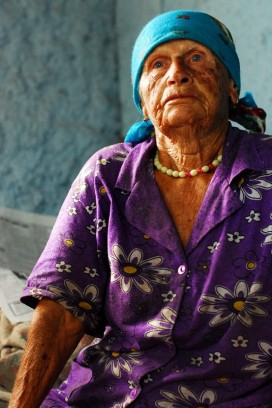
Olga R., born in 1923 :
"Question: Were there Jews in the village during the war?
Witness: Yes, they were brought here for work. They were housed over there, in a cowshed. The kolkhoz used them for labor so they worked there. Then one day they arrived and took them away. Some were taken to Bohdanivka, others were shot. The ones who couldn’t walk were shot and thrown into the pit, some of them still alive.
Q: Did the Jews stay in the cowshed for long?
Witness: Just one night. They were brought here from Odesa in the early evening. They spent the night there, and the next day they were taken...
Q: Where were they shot?
Witness: Over there, in the pit.
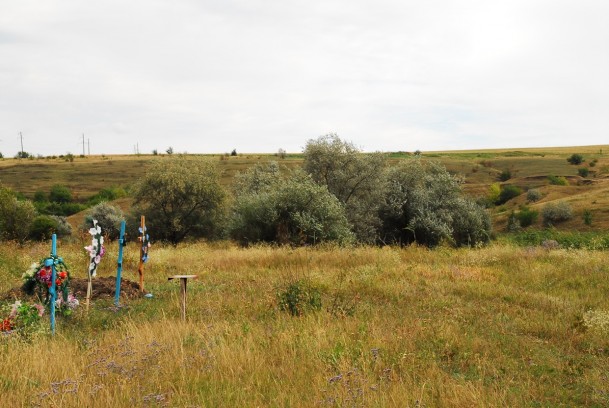
Witness’s daughter: There’s a pit near the cemetery. You can still see it.
Witness: Lower down than the cemetery. The cemetery is right there, and the pit is a bit lower. The pit had been dug there and then…
Q: Did you see them being shot?
Witness: Of course.
Q: Did you see How the people were [shot]? Tell us.
Witness: They [the Jews] were brought here, and we went to see.
Q: Were they shot directly in the pit?
Witness: Yes. They shot them and pushed them into the pit. And there were a lot of children.
Q: Were you able to get close to the pit? Was it allowed?
Witness: Yes. We even begged them to give us the children, not to shoot them. There were toddlers... But...
Q: Was it during the day?
Witness: In broad daylight, around 11 or 10 a.m.
Q: When was it? In the winter or in warm weather?
Witness: No, not in winter. The weather was nice, I think it was spring.
Q: Who shot them? The police, or...?
Witness: The policemen. The Germans stood by and forced the police to shoot. No, I was mistaken. They were Romanians, not Germans. On that side of the Bug, there were Romanians.
Q: With submachine guns or rifles?
Witness: Submachine guns.
Q: Had the pit already been dug over there?
Witness: They [the Jews] had to dig it themselves, they were forced to. And once the pit was dug, they were shot the next day.
Q: Did the shooting last all day?
Witness: No, two or three hours and it was over.
Q: Was the pit then covered up?
Witness: Yes. They [the Jews] covered it up themselves. The strongest were selected and they filled it in, then they were loaded onto carts and taken to Bohdanivka. And some were taken there on foot." (Testimony N°YIU1582U, interviewed Novolikarske, on August 14, 2012)
Novolikarske is a village in Mykolaiv Region, situated approximately 25 km (15 mi) from Voznesensk. There is currently no reliable evidence of an organized Jewish community in Novolikarske before 1941. This does not necessarily exclude the presence of individual Jewish residents, but available sources are insufficient to establish the existence of a permanent or significant Jewish population in the village.
Following the launch of Operation Barbarossa in June 1941, Novolikarske was occupied by German forces in August 1941 and subsequently placed under Romanian administration.
The village was situated along a major thoroughfare leading from Odesa to Bohdanivka, via Mostove and Domanivka. This route was later termed the "Road of Death" by Jewish survivors, as thousands of Jews deported from Odesa were marched along it on foot over several weeks toward the Bohdanivka camp, with hundreds perishing from cold, hunger, and exhaustion along the way, alongside frequent stops and mass shootings in the villages lining the route.
According to testimony provided to Yahad - In Unum by local witness Olga R., born in 1923, in spring a column of Jews was brought to the village from Odesa in the early evening and confined overnight in a local kolkhoz cowshed. A portion of the detainees was used as forced labor on the collective farm. On the evening of their arrival, the perpetrators selected the strongest among them to dig a pit near the village cemetery.
Around noon the following day, a selection was carried out. The able-bodied Jews were forced to continue toward Bohdanivka, transported either by cart or on foot. The weakest detainees however, those unable to walk, as well as numerous young children and toddlers, were brought to the pit dug the previous day. Local policemen carried out the killing, shooting under the command and direct supervision of Romanian soldiers. The mass shooting lasted approximately two to three hours. Olga R. and other young Ukrainian women attempted to intervene to save the young children and toddlers, but without success. Witnesses observed the victims being shot at the edge of the pit and pushed inside, some of them still alive.
A small group of able-bodied Jews were forced to cover the pit immediately following the massacre. Upon completion, they were also forced to go the Bohdanivka camp. To this day, no memorial marks the killing site in Novolikarske.
Do you have additional information regarding a village that you would like to share with Yahad ?
Please contact us at contact@yahadinunum.org
or by calling Yahad – In Unum at +33 (0) 1 53 20 13 17