.jpg&f=jpg)
.jpg&f=jpg)
.jpg&f=jpg)
.jpg&f=jpg)
.jpg&f=jpg)
.jpg&f=jpg)
.jpg&f=jpg)
.jpg&f=jpg)
.jpg&f=jpg)
1 Killing site(s)
Stanisława K., born in 1931: "My father was a shoemaker, and I grew up in a house with seven siblings. We lived in the same building as our Jewish neighbor, Wolf Cymerman, and our families were on very good terms. One of Wolf’s sons managed to leave for Russia in 1938 and survived the war, eventually returning to Wolbrom after 1955. However, his other son was killed just before the deportations began, though I never knew why. I remember seeing his wife, Malcia, and their children being forced to the market square. From there, they were driven to the train station where thousands of Jews from Wolbrom, Pilica, and Żarnowiec were gathered to be deported to the camps." (Witness N°YIU1226P, interviewed in Wolbrom, on December 17, 2020)
On September 5, 1942, 300 Jews from Wolbrom were shot and buried in the Olkusz forest. According to a witness, victims who were still alive were finished off with shovels by members of the Baudienst (a Pole, a member of the Wolbrom Baudienst, had confessed this to the witness’s brother). The shooting took place on the day of the deportation of the Jews from the Wolbrom ghetto. People shot were the individuals who, unable to walk, had been placed on wagons to be taken to the station; in reality, all these people (the sick, the elderly, etc.) were driven directly to the execution site. The remaining Jews from the Wolbrom ghetto were taken to the railway station, where they underwent a selection process. They remained there for five days (some who had arrived earlier had been there for two weeks), sleeping on the marshy ground. Jews from Żarnowiec and Pilica were also present. In total, there were 10,000 Jews at the station. During the selection, 2,500 healthy Jews were chosen for forced labor, while the remaining 7,500 were sent to Bełżec. [Summary of a testimonial; Holocaust Survivor Testimonies Reel #32 page 59 pdf AZIH 301/3263 Olkusz, Wolbrom]
Town of Wolbrom Questionnaire on mass executions and common graves.
1. Date and place of execution: from the middle of September 1942 until the end of 1944, at the Jewish cemetery in Wolbrom.
2.Type of execution / shooting, hanging, or other types: shooting.
3. Data concerning the executed victims:
Poles, Jews, foreigners: primarily Jews. It has been established that one Pole was shot. Name unknown.
Number of persons executed: approximately 400 people.
Origin of the victims: the victims were caught in the town and the surrounding area. They were taken to the cemetery and shot there. This occurred after the expulsions of the Jews, which took place in the first half of September 1942. From time to time, groups of more than ten people were taken to the cemetery and executed.
Name, age, profession, and address: [Blank]
4. Is it known what the victims were accused of, or was the execution an act of reprisal or otherwise? The Jews were shot because they were not Aryans. The Pole was shot for illegal trade.
5. Who carried out the execution? Gendarmerie, Gestapo, SS, police, Wehrmacht? The Wolbrom Gendarmerie.
6. Are the names of the perpetrators known? Give names: Commander Baumgarten, Gendarmes Alsdorf, Bulowski, and Arnt. The names of the other executioners are unknown.
7. Were the bodies burned? Or destroyed in another way? Where? The bodies were buried in several pits at the cemetery. Due to the degradation of the cemetery, it is impossible to locate these pits.
8. Where were the corpses buried? Exact location: at the Jewish cemetery in Wolbrom.
9. Description of the pit(s) / dimensions, probable number of victims per pit: it is impossible to clarify this point.
10. Has an exhumation of the bodies been carried out? Was there a protocol at the site of the pit? No exhumation of the bodies has been performed.
11. Are there reasons to request a forthcoming exhumation? There are reasons to request a forthcoming exhumation of the bodies.
[IPN, Kr 1/11627/DVD/1, p. 9-10 of the PDF; Deposition of Władysław Haberko, aged 50, Mayor of the town of Wolbrom, dated November 22, 1945, concerning the execution of approximately 400 Jews.]
Wolbrom is a town in Olkusz County, Lesser Poland Voivodeship, in southern Poland.
Jews began to settle in Wolbrom between 1655 and 1660. As early as 1740, they became independent from the Olkusz community and established their own autonomous Jewish community. Jews were engaged in the trade of agricultural products, produced and sold alcohol, and were also factory owners. Initially, the town did not have its own Jewish cemetery, and the deceased were buried in Olkusz. Followers of Judaism obtained permission to establish a cemetery in 1736, while the construction of a synagogue began in 1751.
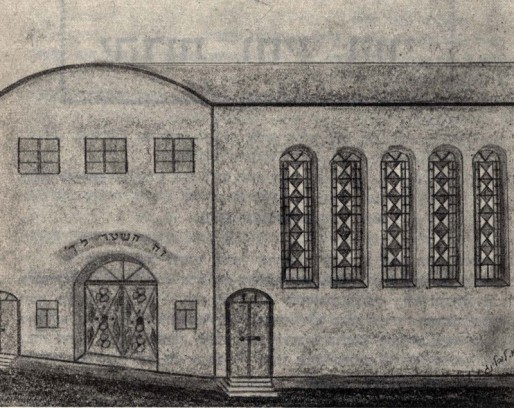
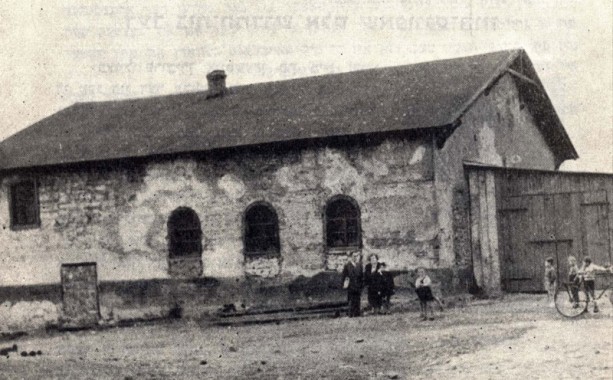
Between 1897 and 1921, the number of Jews increased from 2,901 to 4,276 (59%). Before the outbreak of the war, approximately 5,000 Jews lived in Wolbrom. They ran 356 workshops and small factories (mainly textiles). They had a synagogue, mikveh, cheder and a cemetery.
Wolbrom was occupied by German troops on September 5, 1939, and random shootings targeting the Jewish population began as early as the following day. Anti-Jewish measures were introduced shortly afterward: Jews were forced to wear armbands, forbidden from leaving the town, and subjected to forced labor, particularly in the forests, where they dug trenches and carried out street-cleaning work. A Jewish Council (Judenrat) was established, along with a Jewish police force.
In May 1941, the occupiers created an open ghetto near the synagogue, concentrating several thousand people there, including deportees and refugees from other towns such as Kraków and Łódź. By April 1, 1942, the registered population of the Wolbrom ghetto had reached 4,940 Jews, leading to extreme overcrowding, with more than 20 residents living in a single house on average.
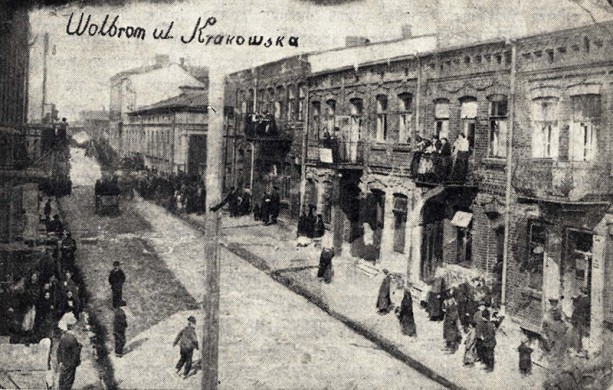
According to archival documents from the Court Inquiries into Executions, the liquidation of the Wolbrom ghetto began on September 5, 1942. The Aktion was carried out by the SS and Ukrainian auxiliaries, with support from the German Gendarmerie and units of the Polish Blue Police. More than 6,000 individuals, including large numbers of refugees, were assembled in the town square. During the roundup, around 300 elderly and infirm people were separated from the crowd and transported by cart to the Olkusz Forest, adjacent to the Jewish cemetery, where they were shot and buried in several mass graves.
The remaining population was then forced toward a marshy area near the Wolbrom railway station. The assembly eventually grew to more than 7,000 people as Jews from nearby localities, including Żarnowiec and Pilica, were also brought there. Some archival sources place the total number as high as 12,000. Following a selection, approximately 2,500 able-bodied individuals were assigned to forced labor, while the remaining thousands were deported to the Bełżec killing center. A final deportation of the Jews who remained in Wolbrom took place in November 1942.
Those who managed to escape the deportations were systematically hunted down and murdered. A 1945 deposition by Mayor Władysław Haberko, born in 1894 and preserved in the Institute of National Remembrance archives in Kraków, confirms that the Jewish cemetery in Wolbrom was used as a killing site. The Wolbrom Gendarmerie shot approximately 400 individuals there between late 1942 and 1944 after they had been captured in hiding. Available records indicate that only around 300 Jews from Wolbrom survived the war.
Do you have additional information regarding a village that you would like to share with Yahad ?
Please contact us at contact@yahadinunum.org
or by calling Yahad – In Unum at +33 (0) 1 53 20 13 17