
_865_924.jpg)
_858_924.jpg)
1 Killing site(s)
Ivan Y., born in 1926: "When I arrived there the following day, I could see the final traces of the burned bodies. It was terrifying. Afterward, the pit was covered. However, during the rain, the bones [that had not been fully consumed by the fire] drifted into the estuary. I was told that the Jewish people were shot by German colonists. There were 17 of them. Two Jews were forced to throw the bodies into the ravine and were promised that they would not be killed. Nevertheless, they were also shot." (Testimony N°YIU1576U, interviewed in Odradna Balka, on August 13, 2012)
"On March 15 and 16, 1942, Soviet citizens displaced from Odesa and Western Ukraine were shot. The shooting was carried out on the eastern side beyond the hamlet, about one hundred meters from the house of Ivan Petrovych Berkuts, in the ravine. The shooting was carried out by German colonists from Tartakai, led by a German officer, who shot the victims with rifles. In total, more than 200 people were shot, including small children, women, and the elderly. The commission established that there were approximately 70 children. The pile of bodies of those who had been shot and those who were sometimes only wounded was covered with straw and burned." [Act No. 15, drawn up by the Extraordinary State Soviet Commission (ChGK) on September 10, 1944, in the hamlet of Stadnaya Balka [today Odradna Balka], part of the Gouliayevka [today Huliaivka] Village Council; Copy USHMM RG.22-002M, Reel 6 (29), p.35]
Odradna Balka, located in the Berezivka district of Odesa Oblast, lies approximately 96 km (59.6 mi) northeast of Odesa.
In the 19th century, the area formed part of the Kherson Governorate of the Russian Empire and was included in the zone of Jewish agricultural colonization established by the tsarist authorities. The Berezivka district was also characterized by a significant presence of ethnic German settlers (Volksdeutsche). Following the Revolution, the region became part of the Ukrainian Soviet Socialist Republic.
According to Yahad-In Unum witness Liudmyla V., born in 1930, there were some Jewish residents living in Odradna Balka, but all of them evacuated prior to the outbreak of World War II.
Odradna Balka was occupied by German forces in the summer of 1941 and, in August 1941, was transferred to the Romanian civilian administration as part of the Transnistria Governorate.
In the beginning of 1942, in winter, several hundred Jewish people, including men, women, children, and the elderly, were brought to Odradna Balka. They had been deported from Odesa and, according to archival sources, also from Western Ukraine. According to a local witness interviewed by Yahad-In Unum, Ivan Y., born in 1926, Jewish families tried to find housing with local inhabitants upon arrival, but the Romanians chased them out. Subsequently, the victims were placed in two buildings in Odradna Balka: approximately 200 people were held in the kolkhoz pigsty and another 100 people in a separate large building. Difficult living conditions, including cold, hunger, and the typhus epidemic that broke out, resulted in the death of numerous detainees within several weeks of their stay in the hamlet. Ivan Y. stated that the victims’ bodies were buried at the base of the hill in Odradna Balka.
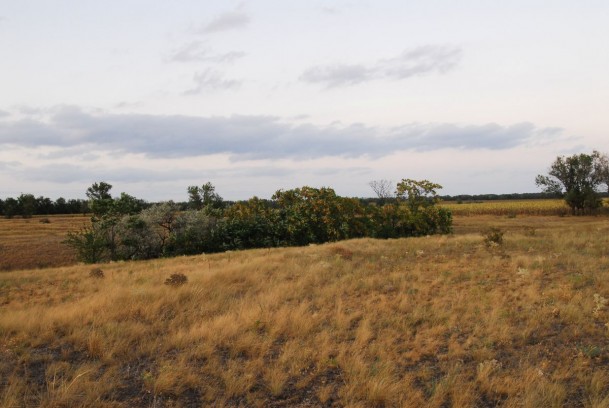
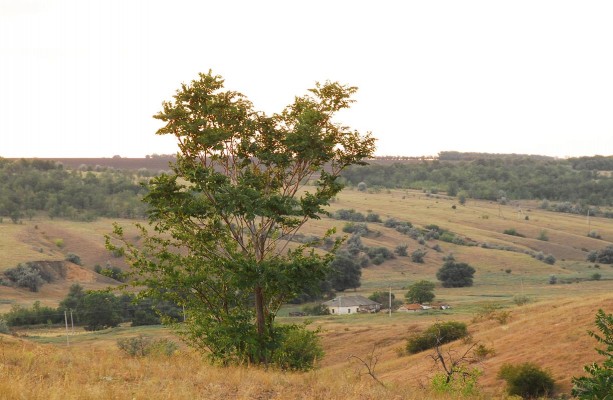
On March 15 and 16, 1942 (or March 22 according to other sources), the remaining Jews, including approximately 70 children, were taken to the ravine, located on the eastern side beyond the hamlet. There, they were forced to undress and align in groups on the edge of the ravine where they were shot by the German colonists from Tartakai, under the supervision of a German officer. Those who did not fall directly into the ravine were thrown there by two Jewish men who had been ordered to do so and who were also shot afterward.
Following the shooting, the victims’ bodies were covered with straw and burned. Shortly afterward, the remains that had not been fully consumed by the fire were covered with earth. While Soviet archival records state that over 200 Jews were murdered during the Aktion in a single day, an information report from the inspector of the Gendarmerie in Transnistria records that 180 Jews were shot in Odradna Balka in March 1942.
After the Aktion, the Jews caught in hiding were transferred to Mostove where they were murdered.
Today, the killing site in Odradna Balka remains unmarked, and the victims have no formal place of commemoration.
Do you have additional information regarding a village that you would like to share with Yahad ?
Please contact us at contact@yahadinunum.org
or by calling Yahad – In Unum at +33 (0) 1 53 20 13 17