
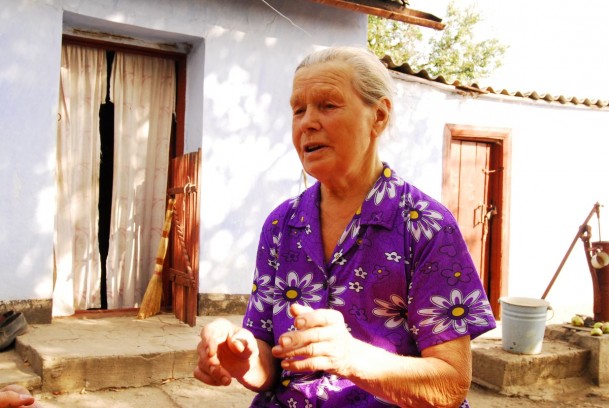
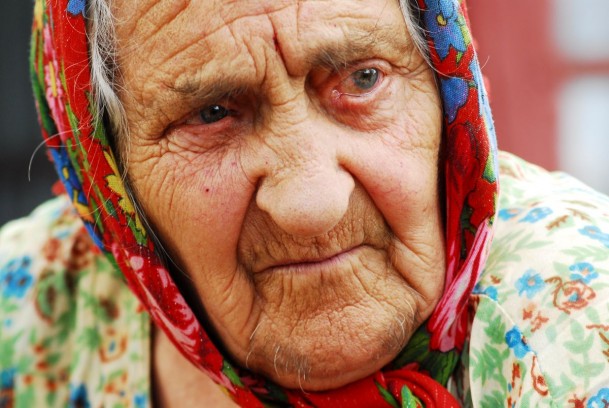
![Lidia H., born in 1925: “Three 16-17 year old Jewish girls came to our house to ask for food. They told me that when the column was marched [from Odesa], people who were too weak to keep up were shot along the road.” ©Les Kasyanov/Yahad - In Unum](/thumb/cache/2239f26349aef4310e9588c95da54fc9/211758/media_fichier_YIU_UKR33_Odessa_Mykhailo-Oleksandrivka_T1518_625_924.jpg)


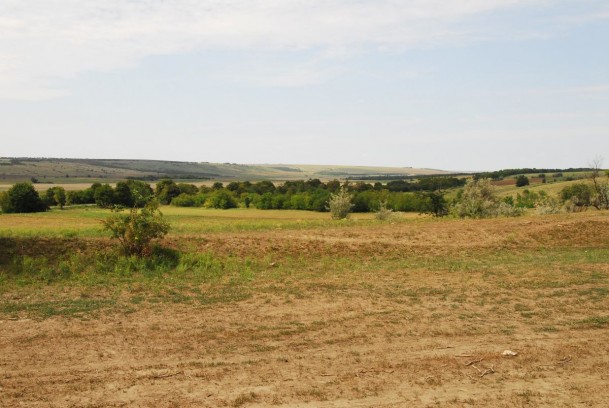
1 Killing site(s)
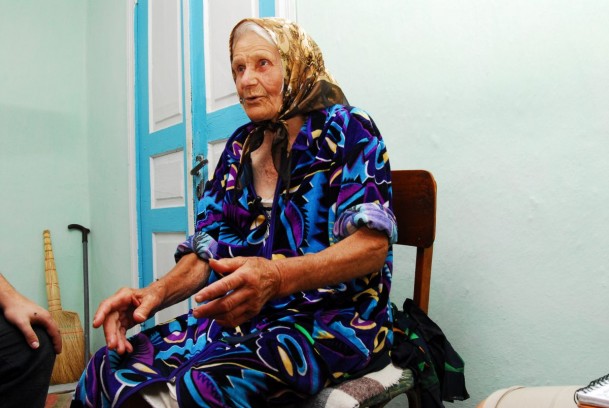
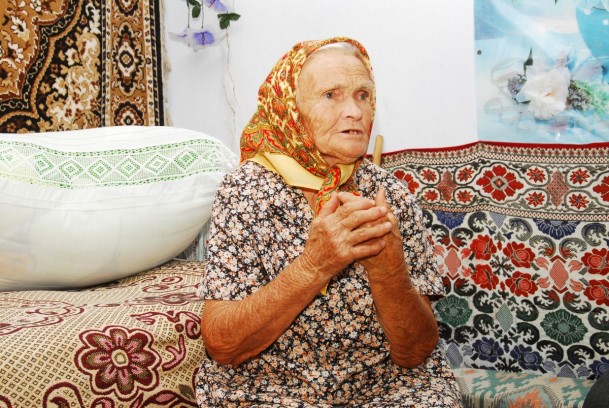
Anna A., born in 1928: "I remember the column of Jews being brought to our village, Mykhailo-Oleksandrivka. It was winter, in February, and the weather was very cold. There were children, women, men, and elderly people in the group—everyone from the very young to the old. I think there were entire families. Everyone was on foot, even the children, and they were walking slowly. I don’t know if the guards were Romanians or local policemen, but they were on horseback. Everyone was tense, even the children. When they got here, they were confined to a warehouse. It had been used as a grain storage facility, but at that time it was empty. Local residents were allowed to bring some food to the Jews inside. Then, the Jews were led to a ravine, from where I heard gunfire and screams. Then we saw fire, because their bodies were burned shortly afterwards.” (Testimony N°YIU1559U, interviewed in Mykhailo-Oleksandrivka, on August 09, 2012)
"I, the undersigned, F.R. Garbouz, witnessed the atrocities committed by the German fascist occupiers against Soviet civilians who lived on Soviet territory temporarily occupied, in the village of Bernadovka [today Chyzhove].
On February 2, 1942, 880 Soviet civilians escorted by Romanian gendarmes were brought to the village of Bernadovka. Out of these, 480 were locked inside the stable of the "Harvest Day" kolkhoz (collective farm), and the remaining 400 were sent to the village of Mykhailo-Oleksandrivka in the Berezovka [today Berezivka] district.
Around February 13, 1942, the 400 Soviet civilians of Jewish nationality who were in Mykhailo-Oleksandrivka were shot by the Germans at the Zhovtnivka wine-producing sovkhoz (state farm), in the municipality of Zavadovka [today Zavadivka], Berezovka district, inside a quarry from which sand was extracted for road construction.
The 480 people who remained in a stable in Bernadovka were shot by the Germans on February 18, 1942. They were shot in lime pits located 300 meters outside the village. All the Soviet civilians, who were shot with rifles and submachine guns, were sprayed with flammable liquid and burned during the night of February 19, 1942. The civilians shot at the Zhovtnivka [today Vynohrad] wine-producing sovkhoz were also sprayed with flammable liquid and burned. The victims were men, women, elderly men and women, and children. They were shot half-naked. The execution was commanded by a German officer whose last name I do not know, with the participation of local German colonists who lived on the Technikum farm and other places within the Berezovka district. I do not know their last names either, with the exception of one, Schmidt, who was the chief policeman in Technikum." [Deposition of F.R. Garbouz, given to the Extraordinary State Soviet Commission (ChGK) on September 18, 1944; Copy USHMM RG.22-002M, Reel 6 (29), pp.41-42]
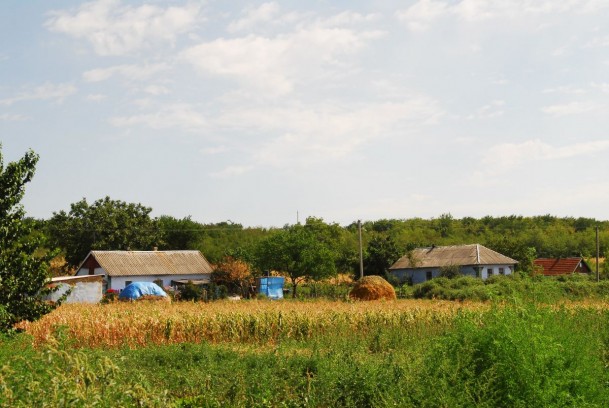
Mykhailo-Oleksandrivka, located in the Berezivka district of the Odesa Oblast, lies approximately 108 km (67 mi) north of Odesa. Following the revolution, the region became part of the Ukrainian Soviet Socialist Republic. During the Soviet period, notably in the 1920s and 1930s, the area underwent significant agricultural development, leading to the re-organization of local settlements and the creation of collective farms (kolkhozes). The Berezivka district was therefore characterized by a significant presence of Jewish agricultural colonies, as well as numerous ethnic German settlers, known as Volksdeutsche.
According to available sources and local witness testimonies, however, there were no Jewish residents living in Mykhailo-Oleksandrivka on the eve of the Second World War.
Mykhailo-Oleksandrivka, like the rest of the Berezivka district, was occupied by German troops in early August 1941 and, at the end of the same month, was transferred to the Romanian civilian administration as part of the Transnistria Governorate.
On February 2, 1942, 880 Jews from Odesa, including men, women, children, and the elderly, were escorted by Romanian gendarmes to the village of Bernadovka, today renamed Chyzhove. While 480 of them remained there, the other 400 victims were taken further to the nearby village of Mykhailo-Oleksandrivka and placed under guard in an empty warehouse. This information was confirmed by local residents interviewed by Yahad - In Unum who had brought food to the detainees. According to these witnesses, while most of the Jews were confined to the warehouse, a few were temporarily sheltered by locals in their homes.
Around February 13 or 18, 1942, the prisoners, including those hidden by locals, were rounded up and taken to the nearby Zhovtnivka wine-producing sovkhoz. There, they were shot in a sand quarry (or lime pit according to Lidia H., born in 1925). The shooting was carried out by ethnic German colonists under the command of a German officer. During the night of February 19, 1942, the victims’ bodies were doused with flammable liquid and burned. Archival sources indicate that 400 Jews in all were killed in Zhovtnivka during this period.
According to the testimony Lidia H., born in 1925, three young Jewish girls aged 16 to 17 were shot in Mykhailo-Oleksandrivka itself. After coming to the witness’s house to ask for food, they were denounced as fugitives and searched. Upon leaving the house, they were immediately captured and shot in one of the three silo pits located by the warehouse. The same witness noted that subsequently the bodies of the three girls were exhumed and moved elsewhere.
Today, the killing site of the Jews in Zhovtnivka, which has been since renamed Vynohrad, remains uncommemorated.
For more information about the killing of Jews in Chyzhove, please follow the corresponding profile.
Do you have additional information regarding a village that you would like to share with Yahad ?
Please contact us at contact@yahadinunum.org
or by calling Yahad – In Unum at +33 (0) 1 53 20 13 17